

- Publikuar
- Autorët
- Florian NEPRAVISHTA, Gjergj THOMAI
- ISBN
- 978-9928-131-83-6
- Shikime
- 681
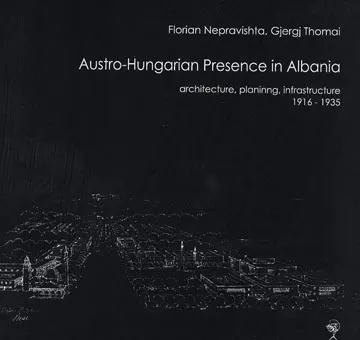
When thinking of Albania, associations with Austria do not immediately
come to mind. The countries are too far apart geographically, have dif-
ferent historical developments behind them as well as different cultures.
For example, while Austria has always been mainly determined by the
Austrian Empire, the Ottomans played an essential role in Albania, as did
the Italians, who had established bases for maritime trade here along Al-
bania's Adriatic coast since ancient times.
But for a short time, there was also a connection between Albania and
Austria, which still characterizes the Albanian country today. Between
1916 and 1935, the influence of the Austro-Hungarian monarchy extend-
ed far into the Balkans, even into Albania. Architects and engineers who
had been trained in Austria were sent to the new regions to construct
buildings, roads, bridges or railways. Thus, in a short time, towns and villag-
es were shaped by Austro-Hungarian influences, such as the city layout
of Tirana, or the many engineering constructions that can still be found
throughout the country today. To this day, this chapter of history has re-
ceived little attention, which is one of the reasons why there are hardly
any publications about the architecture and engineering buildings of the
Austro-Hungarian era. The few books and articles on the subject are then
only available in Albanian, but not in English or German, which would be
important to bring them closer to a broader audience. This publication is
now one of the few that deals with this part of the history of architecture
and urban development.
Si ju duk ky postim?
Pëlqimet
0 pëlqime 0 mospëlqime
Vlerësimi
Ende pa vlerësime
Identifikohuni për të pëlqyer, vlerësuar dhe komentuar postimin.
Identifikohu
Komente 0
Ende nuk ka komente.
Identifikohuni për të komentuar ose për t'iu përgjigjur një komenti.